Program Overview
Advancing IDIA’s mission to drive tangible impact across the region, the Digital Innovation Summer Industry Graduate Internships program connects Mason’s top-tier graduate students with leading industry partners. Modeled collaboratively after the university’s successful Summer Research Assistantship, this program fully funds student placements at selected digital innovation companies.
For companies, the program provides risk-free, all-expenses-covered access to exceptional digital talent and a direct gateway into the broader Mason research ecosystem.
For students, the internship enriches their academic research with hands-on, real-world experience and invaluable connections at companies working on the cutting edge of digital innovation.
For faculty, the embedded student engagements serve as a strategic bridge to establish strong foundational relationships with corporate partners that can organically evolve into long-term, high-impact research collaborations.
Are you an industry leader looking to accelerate your digital R&D while connecting with the region’s top emerging talent?
Submit a Needs Request
Use the form below to tell us about the digital innovation challenges your company is facing. Our team will review your needs and work with you to design a targeted graduate internship project for next year’s cohort.
Program Details
Funded by the George Mason Graduate Division, this program provides financial support to graduate students executing applied research projects alongside regional industry partners.
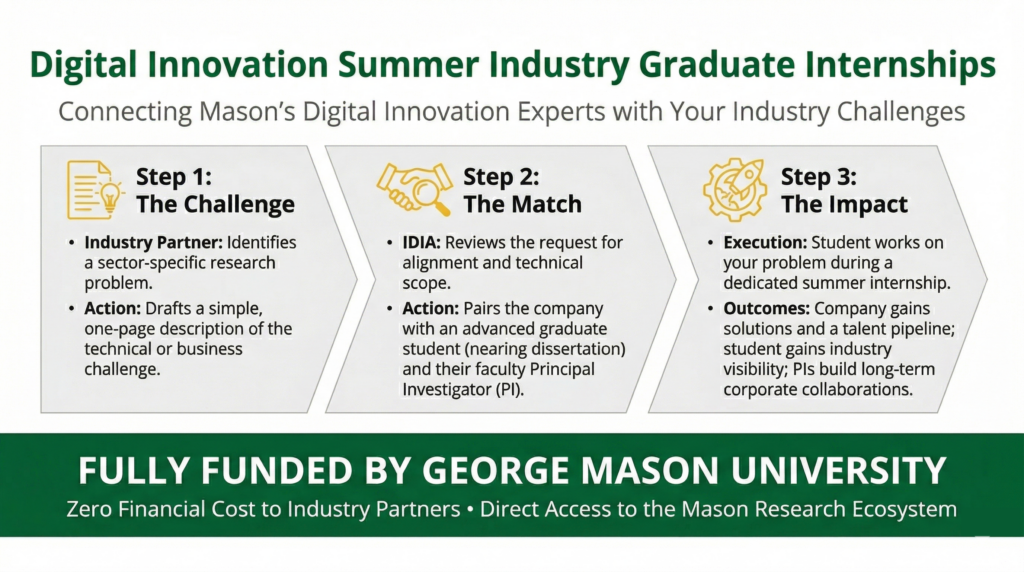
The program cycle begins with industry partners expressing research needs in the digital innovation space and requesting support from the George Mason research ecosystem. IDIA vets these requests, confirms technical alignment with George Mason research capabilities and technical scope, and matches the request with one or more graduate students with relevant research expertise and interests. Upon agreement from all involved parties (company, student, student’s advisor), IDIA confirms the match and works with the Graduate Research Division for funding authorization.
Financial Support: Selected interns receive a competitive summer stipend (e.g., $9,000 for doctoral students) to support their dedicated focus on this industry-led research effort. George Mason University will process and distribute all stipend, benefits, and tuitions payments directly to the student for the duration of this program.
Eligibility and Requirements
- Companies Eligibility: Open to companies (for-profits and non-profits) and other organizations conducting research, development, demonstration, or commercialization of digital innovation technologies and services. Organizations must be incorporated in any State or the District of Columbia, but must have a presence in Virginia.
- Students Eligibility: Open to currently enrolled George Mason University Master’s and Doctoral students in good academic standing (cumulative GPA of a 3.0 or higher) and not be scheduled to graduate at the end of the spring or summer semester of the year of the internship. Specific internship projects might include additional eligibility criteria related to US citizenship, country of origin, security clearance, and/or other requirements expressed by the host company. IDIA will confirm whether additional eligibility criteria must be met on a case-by-case basis.
- Timeline: Any activity or effort related to this internship should be conducted during the George Mason summer term (May 25th – August 24th for the academic year 2025/2026). Flexible arrangements can be discussed.
- Intellectual Property: Any separate agreement between the company and the student, alongside the company’s internal policies, will govern the primary intellectual property relationship and any invention claims developed as part of this program. George Mason University “Patenting University Inventions” policy specifies the circumstances under which the university may assert an interest in intellectual property generated during this internship, in cases where university funds or resources are substantially utilized for this effort.
- Other requirements:
- The work conducted as part of this internship must be performed in the United States, possibly in the Commonwealth of Virginia. No foreign work is allowed as part of this program.
- Individual companies may include additional requirements related to in-person presence at their location within the Commonwealth of Virginia occasionally or with certain frequency.
- Individual companies might require additional background check and/or other onboarding tasks to be completed before the beginning of the internship.
Expectations
For Companies: Host organizations are expected to:
- Onboard the intern and provide access to any infrastructure (IT, laboratory, facility) necessary to work on the research project.
- Identify a mentor that can guide the intern through the effort and maximize benefits for the company and the student. The mentor should ensure well-being of the intern, access to any resource needed to work on the project, facilitate interactions and engagement with key company’s employees, set clear and reasonable expectations for the research project.
- Attend the Digital Innovation Internship Kickoff and learn about the broader George Mason research enterprise.
- At the end of the summer term, fill out a survey to capture the experience and the impact of the internship.
For Students: Interns are expected to concentrate fully on their internship research during the summer term and should not accept additional internal assignments or outside employment. Interns are required to:
- Attend the Digital Innovation Internship Kickoff.
- Keep their faculty advisor actively informed of their progress and industry activities.
- At the end of the summer term, fill out a survey to capture the experience, a final summary of the work, and impact of the internship.
- (For Doctoral Students) Prepare to compete in Mason’s 3MT™ (Three Minute Thesis) using the research developed during the internship.
For Faculty Advisors: To ensure optimal student success, this program relies on the continued support and mentorship of the intern’s faculty advisor. Advisors are encouraged to:
- Help students identify early how these industry partnerships can be leveraged into their master’s thesis or doctoral dissertation.
- Engage directly with the partner organization during the summer. One of IDIA’s core goals is to use these student placements to seed ongoing, fully funded research partnerships between Mason faculty and external companies. IDIA staff will provide support to facilitate these long-term institutional relationships.
Summer 2026 Internship Matches
Below are the internship matches for the 2026 cohort. Explore more how George Mason is helping external organizations solving their digital innovation challenges.
Akiak Technology – AI Cybersecurity Product Development
Core Technology: Software Intelligence
Application Domain: Governance and societal framework
Student: Arka Ghosh
Industry Partner: Akiak Technology
Akiak Technology is developing an AI product suite designed to automate a substantial part of the Authority To Operate (ATO) process for federal systems. The goal is to dramatically speed up the ATO process, enable Continuous Control Monitoring (CCM), and automate the creation of System Security Plans (SSPs) tied to dynamic system configurations and federal regulations. This involves developing and integrating a suite of artificial intelligence product modules, automating the generation and updating of system security and assessment plans, and implementing automated protocols for security testing, vulnerability scanning, findings determination, and risk response prioritization. Comprehensive software lifecycle activities will be executed, encompassing requirements research, product development, system testing, and production deployment.
American Institutes for Research (AIR) – AI Developer Intern (2 positions)
Core Technology: Software Intelligence
Application Domain: Digital Society & Civic Innovation
Students: Hadeel R. A. Elyazori, Shahana Shultana
Industry Partner: American Institutes for Research
The intern will support AI/ML development efforts across various applied research areas, including ethical AI and agentic automations. The primary goal is to build cloud-based and on-premises applications, conduct deep learning architecture assessments, and develop user interfaces. The intern will architect and build components of complex agentic applications and cloud data pipelines utilizing platform-as-a-service or open-source tools. Additionally, the project involves developing large language model (LLM) and small language model (SLM) solutions to support business operations and research project delivery. The digital innovation challenge centers on creating reusable model frameworks and implementing procedural systems to verify the accuracy and trustworthiness of AI-based systems, all while providing innovative solutions to complex behavioral and social science problems.
American Institutes for Research (AIR) – Data Scientist Intern (3 positions)
Core Technology: Software Intelligence
Application Domain: Governance and societal framework
Students: Haolin Li, Vrinda Malhotra, Yakub Rabiutheen
Industry Partner: American Institutes for Research
The intern will support applied research and evaluation projects by building data pipelines, cloud-based applications, and ensuring data reproducibility across studies. The intern will develop comprehensive data visualizations, dashboards, and reporting mechanisms using open-source or business intelligence platforms. Key goals include conducting quantitative and qualitative data analysis, computer modeling, and forecasting to derive actionable insights using standard practices and standard software packages. Furthermore, the intern will establish robust systems for data verification, maintain well-documented code in collaborative environments, and coordinate project support needs. The core digital innovation challenge is to generate evidence and apply data-driven methodologies that expand opportunities and address complex societal challenges on both a national and global scale.
Cushman & Wakefield – Fuse Smart Infrastructure Living Laboratory Digital Twin
Core Technology: Physical Systems & Autonomy
Application Domain: Critical Infrastructure & Built Environment
Student: Melchizedek Essandoh
Industry Partner: Cushman & Wakefield & Fuse @ Mason Square
This initiative focuses on exploring methodologies to develop a Digital Twin framework that integrates heterogeneous building data streams into a unified cyber-physical model for the Fuse facility. The research aims to leverage real-time operational data from IoT sensors and Building Information Models (BIM) to support advanced analytics related to predictive maintenance, energy optimization, and infrastructure resilience. The project involves performing data normalization across multiple building automation platforms, establishing a methodology for integrating building automation system telemetry with BIM data, and creating preliminary predictive analytics models. This will culminate in a comprehensive research report documenting findings, methodologies, and recommendations to enhance energy optimization and infrastructure reliability.
Metroscope – AI Copilots to Accelerate Metroscope Diagnosis Model Build
Core Technology: Physical Systems & Autonomy
Application Domain: Critical Infrastructure & Built Environment
Student: Rehenuma Tasnim Rodoshi
Industry Partner: Metroscope
Metroscope aims to prototype a Python-first copilot toolkit to assist engineers in building diagnosis models for industrial assets. The challenge is to reduce the time spent on repetitive setup and analysis tasks while improving output consistency and maintaining human-in-the-loop control with transparent rationale. Workflows will be identified and implemented across various stages of diagnosis model building, such as data filtering, mapping, and fault modeling. The intern will deliver functional Python prototypes, reusable technical components, and a comprehensive final report detailing time saved, quality improvements, and future recommendations.
Solvitur Systems – AI-Driven Cybersecurity Compliance Intelligence for Multi-Framework Readiness Assessments
Core Technology: Cybersecurity & Information Assurance
Application Domain: Critical Infrastructure & Built Environment
Student: Domenico Ditale
Industry Partner: Solvitur Systems
This project investigates AI-assisted techniques, including machine learning, NLP, and knowledge graphs, to automate cybersecurity compliance readiness assessments across multiple regulatory frameworks. The digital innovation challenge lies in overcoming fragmented compliance documentation and manual control mapping to generate actionable, explainable remediation recommendations for audits. Computational models will be designed to map organizational controls and identify equivalent requirements across regulatory frameworks. The project will deliver algorithms or prototype systems to automatically identify compliance gaps and generate recommendations, resulting in conceptual system architectures, explainability assessments, and a final research report.
SylLab Systems – Modeling Space Weather Unpredictability in Digital Twins of Satellites and Software-Defined Systems
Core Technology: Software Intelligence
Application Domain: Climate, Environment & Sustainability
Student: Dennies Kiprono Bor
Industry Partner: SylLab Systems
SylLab proposes building an AI/ML-driven model of space weather unpredictability and applying it to digital twins of satellites and software-defined systems within their validation testbed, STAR. The goal is to establish a baseline operating model, identify key space weather event types, and introduce realistic variability to test whether a space vehicle can maintain mission performance under unpredictable, off-nominal conditions. This requires conducting comprehensive research regarding environmental factors and anomalies affecting space system performance. AI/ML-driven computational models will be designed and integrated to simulate environmental unpredictability. Ultimately, survivability assessments will be executed, and technical reports will be compiled to present findings to engineering stakeholders to inform operational baselines and future research pathways.
Digital Innovation Internship Kickoff
To launch the summer program, IDIA hosts an Internship Kickoff designed to integrate our student interns, their faculty advisors, and our corporate partners.
This half-day, immersive event is built to:
- Prepare the Cohort: Equip the students with professional skills, intellectual property awareness, and agile project management techniques tailored for corporate R&D environments.
- Foster the Ecosystem: Provide a dedicated space for faculty and company representatives to network, share grand digital challenges, and discuss future collaborative research opportunities.
- Highlight Opportunities: Feature keynote insights from regional tech leaders on the future of digital innovation and workforce.
Partner With Us: Host a Fellow in 2027
Are you an industry leader looking to accelerate your digital innovation research and development efforts while connecting with the region’s top emerging talent?
George Mason University covers the cost of the student stipends, making this a frictionless way for your company to explore new technologies, solve complex business cases, and build a relationship with George Mason’s world-class research faculty.
Submit a Needs Request Use the form below to tell us about the digital innovation challenges your company is facing. Our team will review your needs and work with you to design a targeted graduate internship project for next year’s cohort.